
Repurposing Content for Social Media: One Source, Many Native Posts

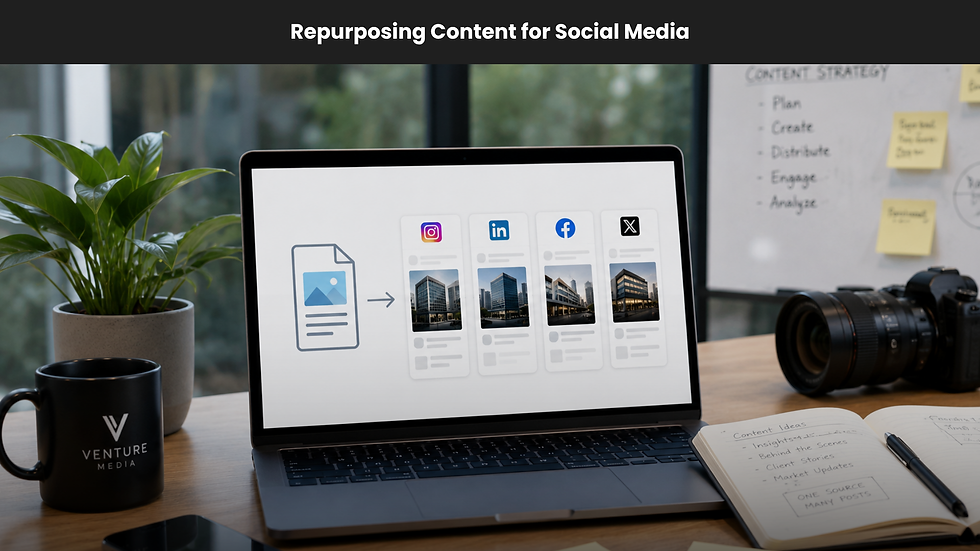
Repurposing Content for Social Media
Repurposing content for social media is the practice of a single idea reaching more people without you creating something new from scratch every time. That is the whole payoff in one line: you multiply reach and reinforce one clear message while doing less original production. Done well, it lifts your engagement rate and your return on investment because you get more value out of work you already did.
This guide teaches a repeatable method, not a pile of tips. You will learn how to pick the right source, break it into standalone ideas, map those ideas to the formats each platform rewards, adapt tone and hook and shape so nothing feels copy-pasted, sequence everything across a calendar, and measure what actually worked.
What Repurposing Content for Social Media Actually Means
Start with the definition, because people confuse this with simply posting more. Repurposing means you take one source, a blog, a video, a podcast, a webinar, and reshape it into platform-native variants that each stand on their own. The source is the raw material. The posts are the finished products, cut and styled for where they live.
The benefit is efficiency that compounds. Instead of chasing a blank page every day, you mine assets you already believe in and turn each into several posts. That consistency is where results come from, since a steady presence tends to earn a better engagement rate and a stronger return on investment than sporadic bursts of brand-new content.
It is worth knowing how common the shortcut version is. Roughly 49.4% of teams reuse the same content across platforms while 39.5% tailor it for each platform. The gap between reusing and tailoring is the entire game. This guide sits firmly on the tailoring side, and the method below is how you get there without burning hours.
Repurposing vs Cross-Posting vs Reposting
These three words get used interchangeably, and that confusion leads to lazy output. Here is the clean distinction.
Reposting shares the same asset again, usually to catch people who missed it the first time. Same file, same platform, second showing.
Cross-posting drops the identical file onto multiple platforms. One video, exported once, pushed to every feed as-is.
Content repurposing reshapes one source into platform-native variants, so a blog becomes a carousel here, a short video there, and a text post somewhere else, each built for its home.
There is a practical reason tailoring matters beyond aesthetics. Pasting identical text across the web can raise duplicate content and SEO concerns, so search and platform algorithms may not reward copies the way they reward native, adapted pieces. Reposting and cross-posting have their place. But repurposing is the one that respects each audience and each platform enough to actually perform.
How to Decide Which Content Is Worth Repurposing
The advice to "repurpose your best content" is useless without a way to define best. So use concrete criteria instead of a gut feeling. A sound content repurposing strategy starts with a short audit, not a guess.
Review your recent content across the channels you actually use. Then sort your assets by three things:
Engagement rate, which tells you what resonated relative to your reach.
Shares, which tell you what people found valuable enough to pass along.
Evergreen value, which tells you what will still be true and useful months from now.
Rank what rises to the top and prioritize that tier first. One nuance worth internalizing: a single viral hit can be a fluke, a lucky headline or a moment of timing. When three separate posts on the same topic all beat your average, that pattern points to durable audience interest, and durable interest is exactly what you want to reshape into many formats. Chase the theme that keeps working, not the one that popped once.
Atomic Idea Extraction: Breaking One Source Into Standalone Ideas
This is the step most guides skip, and it is where the real leverage lives. Before you pick formats, you break the source apart. This is atomic idea extraction: stripping a piece down to clean prose and pulling out the smallest units that can stand on their own.
Here is how to repurpose content at this stage. Read the source and mark every discrete idea inside it. Most long-form pieces contain more than you think:
The headline or core promise
A statistic or data point worth its own post
A key list or set of steps
A strong quote or one-liner
A step sequence or process
A tight summary of the whole thing
If building blocks do not click, use an angle inventory instead. Ask what the source says about a decision, a common mistake, a process, a demonstration, a piece of evidence, a contrarian view, a template, or a question worth debating. Each angle is a separate post waiting to be written.
The outcome surprises people. One well-built long-form post usually holds enough distinct ideas to feed a week of social posts. You are not padding. You are surfacing what was already there, buried inside a single asset because the format hid it.

Source-to-Format Transformations: Blogs, Videos, Podcasts, and Webinars
Once you have your atomic ideas, you map each one to a format. This is where repurposing video content and written content becomes a system you can run on repeat. Think of it as one input feeding many outputs.
From a blog post
A single blog can become a text thread, a LinkedIn carousel that walks through a framework slide by slide, a short hot take built from its most contrarian line, a quote card, and a data post built around one statistic. The list inside the blog often becomes the carousel outright.
From a long-form video
Cut a long video into shorter clips, from quick 15-second moments to fuller two or three minute segments, each anchored on one idea. Add a written recap for readers who will not press play. The same footage feeds short-form video across multiple platforms without new filming.
From a podcast episode
A podcast episode yields several short clips, each built around a single strong exchange, plus quote graphics pulled from the best lines. Audiograms and captioned clips travel well on TikTok and Instagram, where sound and text carry the moment. One podcast episode can repurpose into short-form clips for Instagram and TikTok, long-form on YouTube, audio on streaming platforms, an article, quotes, and text overlays, often yielding many pieces per episode, which makes it one of the most efficient source formats available.
From a webinar
A 60-minute webinar is a goldmine. It can seed several blog posts, a batch of social posts, and an email series, because the questions and answers alone map to dozens of standalone ideas. You can also invite user-generated content by clipping audience questions and responding to them publicly.
The pattern is always the same. One source, broken into ideas, each idea shaped into the format its platform rewards.
Adapting Tone, Hook, Length, and Aspect Ratio So Each Post Feels Native
Mapping a format is only half the work. The other half is making each post feel like it belongs where it lives, not like a memo forwarded to five inboxes. This is the difference between repurposing and cross-posting, and it is where most feeds fall flat.
Start with the hook. On short-form video, the opening moment decides everything. If the first line does not stop the scroll, the rest never gets seen, so lead with the payoff or the tension, never a slow warm-up. A blog can ease into a point. A vertical video cannot.
Respect the shape of the platform. The 9:16 aspect ratio is non-negotiable for vertical feeds on TikTok and Instagram, because a letterboxed landscape clip signals lazy repurposing at a glance. Reframe and recut so the subject fills the vertical space. On the graphics side, text overlays that look like something an organic creator made tend to outperform polished, over-designed cards, since they read as native rather than as an ad.
Then tune tone and length. LinkedIn carousels can carry a more considered, professional voice and a longer arc of thought. A short-form clip needs to be punchy and fast. The same idea can be earnest on one platform and playful on another, and that is fine. You are translating, not just copying. Artificial intelligence tools can speed up drafting captions and cutting clips, but the judgment about what feels native to each audience still has to be yours.
Here is the test. Read the post back and ask whether it looks like it was made for this platform on purpose. If it looks recycled, it is.
The goal is not more posts. The goal is posts that feel at home wherever they land.
Scheduling and Sequencing Repurposed Content Across a Calendar
A week of ideas is worthless if you dump it all in one day. The point of repurposing is a steady, ongoing presence, so you spread your atomic ideas across a content calendar instead of firing them off in a single burst.
Give each day a job. Content buckets keep your feed varied and keep you from repeating yourself:
Education, where you teach one useful thing.
Proof, where you show something worked.
Evergreen resource, where you resurface a durable idea.
Conversation, where you ask a question and invite replies.
Offer or use case, where you connect your work to a real outcome.
Rotate these across the week so no two days feel the same. Alternate formats too, a carousel one day, a short video the next, a plain text post after that, so the feed stays alive rather than monotonous. A practical rhythm is to schedule the ideas pulled from one source across two weeks, which stretches a single asset while keeping variety high. When one source runs dry, you audit the next top performer and refill the calendar. That loop is the engine.
Measuring Repurposed Content Performance and Common Mistakes
You cannot improve what you do not check. Measuring repurposed content is straightforward if you watch the right signals.
Track engagement rate to see what resonated, shares to see what people valued enough to pass on, and return on investment to see whether the effort is paying back in leads, traffic, or customers. Set a recurring review, quarterly works well for most, where you pull your analytics and surface the top performers. Those winners become the source material for your next repurposing cycle, so the system keeps feeding itself.
Avoid the three mistakes that quietly kill results:
Pasting identical files everywhere and calling it repurposing. That is cross-posting, and it reads as such.
Ignoring platform-native hooks, so strong ideas die in the first second because the opening did not earn attention.
Repurposing weak source content. Reshaping a mediocre post into ten formats just gives you ten mediocre posts.
Artificial intelligence can help you cut clips faster and draft variations, but it will not fix a weak idea or a flat hook. Start from something that already worked.
Who This Method Is Not For
Honesty first: this method is not for everyone. If you have not published enough yet to have any track record, you do not have a top tier to mine, so your energy is better spent creating original content and learning what your audience responds to. Repurposing needs a source worth repurposing.
It also has limits when your channels serve genuinely different audiences with opposite needs. In that case, a single source may not stretch cleanly across all of them, and forcing it produces posts that feel native nowhere. And if your best content is time-sensitive news rather than evergreen thinking, the shelf life is short, so the payoff of reshaping it into many formats shrinks. Use the method where it fits, and do not bend it where it does not.
Frequently Asked Questions
Why repurpose content?
Because making something new every day is the fastest way to burn out and go quiet. Repurposing lets one good idea show up in five places instead of one, so you stay visible without starting from a blank page each morning. You're not padding your feed. You're getting full value out of work you already did and believed in.
How do you repurpose content effectively?
Start with a source that already earned attention, then pull it apart before you touch any format. Mark every standalone idea inside it, a stat, a list, a strong line, a step sequence, and treat each as its own post. Only then do you decide where each one goes. The mistake most people make is picking formats first and forcing the content to fit. Ideas first, formats second.
How do you adapt repurposed content so it feels native to each social media platform?
The test is simple: does it look made for that platform on purpose, or forwarded from somewhere else? Lead short video with a hook that stops the scroll, shoot vertical so nothing's letterboxed, and let graphics look like a real person made them instead of a design team. Same idea, different clothes for each place it lands. If it reads as recycled, it is.
How do you measure repurposed content performance?
Watch three things: engagement rate for what landed, shares for what people valued enough to pass on, and ROI for whether it's actually driving leads or traffic. Pull the numbers on a set cadence, quarterly works, and let the winners pick your next source. The point isn't just tracking. It's that this month's top performers become next month's raw material, so the system keeps feeding itself.
Putting the Method to Work
Repurposing content for social media is not a hack, it is a discipline. Pick a source that earned attention, break it into atomic ideas, shape each idea for the platform it lives on, sequence them across a calendar, and check the numbers so your next cycle starts from what already worked. Do that consistently and one week of production can quietly power a month of presence.
If you would rather have a connected system build and run this for you, so every post supports the next and compounds into real authority, that is exactly what our team does at Venture Media. Either way, the method is yours to run.
Conclusion
The strongest repurposing systems do not create more noise. They give proven ideas more chances to land, in the formats and feeds where your audience is already paying attention. Start with one source that earned its place, pull it apart, make every version feel native, and let the results guide the next cycle. That is how a single piece of content becomes a steady engine for reach, engagement, and authority.


Comments