
Podcast Ads vs. Branded Podcasts: Which Boosts Brand Awareness Faster?
- Sam Hajighasem

- 21 hours ago
- 6 min read
Podcast advertising is no longer an emerging channel, it’s a fast-growing strategy for brands that want to connect with highly engaged audiences. But as more marketers enter the podcast space, one question continues to surface: should your business invest in podcast ads or create a branded podcast? Both approaches can build brand awareness, yet they achieve this through very different methods. Understanding the strengths, timelines, and ROI expectations for each is key to making the right choice for your brand.
This guide compares podcast ads and branded podcasts in depth. You’ll learn how each works, their costs, audience reach, return on investment, and how to decide which is best for your brand-building strategy.
What Are Podcast Ads?
Podcast ads are short, targeted messages that brands place within existing podcasts to reach their desired audience. This form of podcast advertising leverages the credibility of podcast hosts and the loyal following of their shows to promote products and services.
How Do Podcast Ads Work?
Podcast ads come in several formats — pre-roll, mid-roll, and post-roll placements. Mid-roll ads typically perform best because they appear in the middle of episodes when listener engagement is highest. Host-read ads, one of the most trusted forms of audio advertising, allow the podcast host to personally recommend a product or service, giving the brand natural credibility and authority.
Modern podcast advertising uses technologies like dynamic ad insertion (DAI), which swaps ad messages in real time based on listener demographics, geography, and campaign goals. This technology helps advertisers scale their campaigns efficiently and measure performance more accurately through pixel-based tracking and brand lift studies.
Why Is Podcast Advertising Effective for Brands?
Podcast ads are effective because they tap into listener trust. Studies show that 75% of podcast fans consider hosts more influential than social media influencers, and 80% trust recommendations made during shows. Additionally, podcasts command more focused attention, research by Acast found that podcast ads receive 10.6 seconds of active attention, nearly double that of social video.
This trust translates into results: 69% of listeners discover new brands through podcasts, 59% feel more positively toward them, and 41% make a purchase after hearing a podcast ad. Combined with the ability to target specific listener segments, podcast advertising gives marketers full-funnel power — building awareness, nurturing consideration, and driving conversions.
What Are Branded Podcasts?
A branded podcast is a full-length show produced by a brand to tell stories, share expertise, and connect directly with its audience. It’s a form of branded content that focuses on delivering value rather than overt sales messages.
How Do Branded Podcasts Boost Brand Awareness?
Branded podcasts strengthen brand awareness by positioning companies as thought leaders and experts in their industries. Rather than interrupting the listening experience with an advertisement, the brand is the experience. Listeners get valuable insight, entertainment, or education, all tied naturally to the brand narrative.
Brands like Shopify, Slack, and McKinsey have used branded podcasts to humanize their message, foster loyalty, and differentiate themselves from competitors. This sustained engagement builds trust over time, creating a loyal audience that deeply identifies with the brand’s values.
Benefits of Branded Podcasts for Businesses
A branded podcast allows brands to:
Establish authority and thought leadership.
Create long-term brand associations.
Build emotional connection and authenticity.
Generate organic word-of-mouth referrals.
Repurpose episodes across social media, blogs, and newsletters.
This long-form storytelling format allows deeper exploration of ideas and encourages sustained audience engagement over weeks or months — a key factor in achieving lasting brand awareness.

Podcast Ads vs. Branded Podcasts: Key Differences
To decide which strategy fits your business, it helps to compare both on core factors: cost, speed of results, scalability, and measurement.
Cost and Resource Comparison
Podcast ads are typically sold on a cost-per-thousand-impressions (CPM) model, ranging from $18 to $50 per 1,000 listens depending on ad type and show size. Host-read ads and mid-roll placements command premium pricing but deliver higher engagement. For meaningful testing and data collection, most advertisers allocate $75,000–$90,000 across 8–12 weeks.
Branded podcasts, by contrast, require greater upfront investment in production, scripting, recording, and marketing. Average budgets range from $50,000 to $250,000 annually depending on production quality and frequency. However, this investment creates enduring content assets that continue driving awareness long after release.
Speed of Results
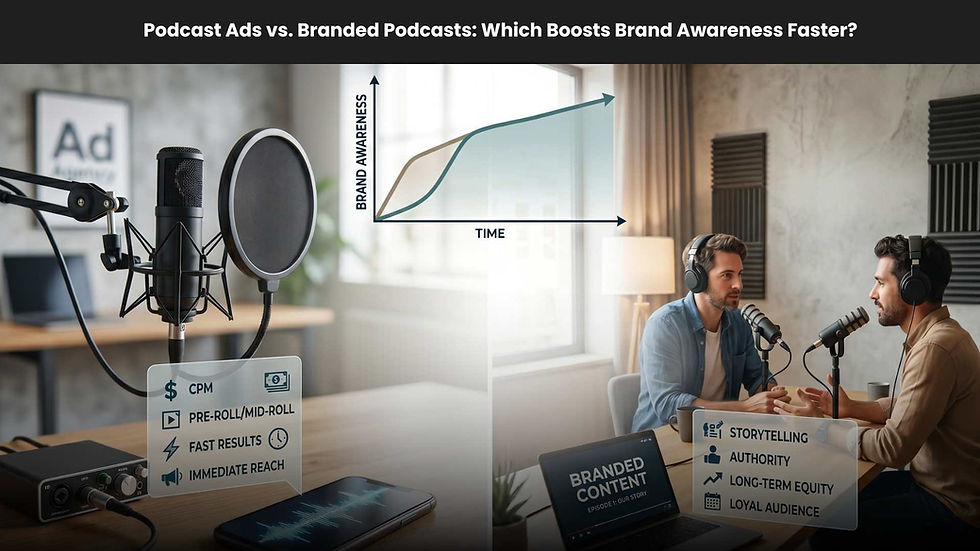
Podcast ads generate measurable outcomes faster. Because they leverage established audiences, your campaign’s reach and brand impact begin almost immediately after launch. Branded podcasts, however, take longer (typically 3–6 months) to build traction, as they depend on consistent content distribution and audience growth.
Longevity and Brand Equity
While podcast ads deliver quick wins in reach and conversions, their effects are typically short-lived once the campaign stops. Branded podcasts build long-term equity, serving as an evergreen brand asset that strengthens reputation and authority over time. For this reason, many companies use branded podcasts to complement short-term advertising with ongoing storytelling.
Measuring Success — Metrics That Matter
Metrics for Podcast Ads
Key performance metrics for podcast advertising include:
Impressions and completed listens
Conversion tracking through promo codes or pixels
Brand lift surveys to measure awareness or intent changes
Cost per acquisition (CPA)
Advertisers now benefit from standardized IAB 2.2 metrics and real-time analytics through podcast ad networks, enabling more transparent ROI measurement.
Metrics for Branded Podcasts
For branded podcasts, success metrics focus on audience engagement and brand affinity:
Listener retention rates
Average consumption time per episode
Audience growth and demographics
Mentions, backlinks, or earned media coverage
Brand sentiment and follower count growth
These metrics indicate whether the branded content resonates with the right audience and supports long-term business goals.
Should You Choose Podcast Ads or a Branded Podcast?
Selecting between podcast ads and a branded podcast depends on your marketing objectives, budget, and timeline.
When to Choose Podcast Ads
You want fast reach and measurable results.
You have a defined conversion goal, such as app downloads or product sales.
You’re exploring podcast marketing for the first time and want lower barriers to entry.
Podcast ads are ideal for performance-driven campaigns or for testing the audio marketing space before committing to full production.
When to Choose a Branded Podcast
You’re focused on thought leadership or long-term brand building.
You have the resources to produce quality episodes consistently.
You want to own your audience, not borrow one through sponsorship.
A branded podcast helps cement your brand story and foster deep, emotional engagement — a valuable asset for industries like finance, tech, and education, where trust is critical.
Hybrid Strategies
Some brands combine both methods. They start by placing podcast ads on trusted shows to test audience response, then launch their own branded series to deepen engagement. This hybrid strategy offers both short-term visibility and lasting brand equity.
Real-World Example: How Leading Brands Combine Both Approaches
Financial and B2B brands increasingly blend ads and owned podcasts. For instance, a financial services brand sponsoring "Hidden Brain" saw a 45-point lift in message association through sponsored segments. Meanwhile, global companies like McKinsey and Shopify leverage branded podcasts to nurture loyal audiences capable of amplifying their influence beyond paid placements.
These examples show the complementary power of both strategies when integrated effectively.
How to Choose the Best Podcast Strategy for Brand Awareness
When deciding on your podcast strategy, ask:
What is your primary goal — awareness, sales, or loyalty?
What resources and budget can you realistically dedicate?
How soon do you need measurable results?
If your goal is quick visibility and testing, podcast ads are your best entry point. If your mission is to build authority and deepen emotional ties, branded podcasts deliver richer, long-term dividends.
Conclusion
Both podcast ads and branded podcasts can accelerate your brand awareness, but in different ways. Podcast ads provide immediate exposure to engaged listeners and drive quick conversion wins. Branded podcasts, on the other hand, establish lasting connections, credibility, and audience loyalty.
The most successful brands don’t see these strategies as competitors, but as partners within a full-funnel audio marketing ecosystem. Start by testing podcast advertising to validate audience alignment, then evolve into a branded podcast to own the narrative and strengthen your position as a trusted authority in your category.
By aligning your approach with your brand goals, resources, and timeline, you can turn the growing world of podcast marketing into a powerful driver of long-term brand growth.



Comments